How to Identify Ant & Termite Swarmers
With warm temperatures settling in, gardeners can expect to see swarming insects appearing more regularly. This is a common springtime – and sometimes fall – occurrence in which reproductives emerge from their colonies and take flight in search of a mate. It most often happens on warm days after significant rainfall, though some species, such as Formosan termites, may swarm at night.

Termite swarmers with and without wings.
“Swarmer” or “alate” are terms used to describe the reproductive stage of ants and termites. When these insects leave the colony, they have wings and take flight to find a mate. After landing, however, they shed or chew off their wings before starting a new colony.
So how can you tell the difference between ant and termite swarmers?
There are three morphological characteristics to look for:
- Antennae
- “Waist” – where the thorax and abdomen join
- Wings – if the insect still has them
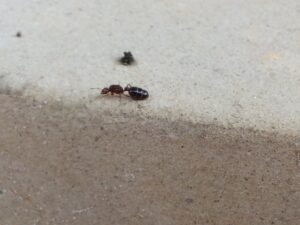
Fire ant swarmer (female) without wings.
Ant swarmers have antennae that are bent at a ninety-degree angle and are said to be “elbowed”. The “waist” area is constricted, narrowed, or pinched. If you find a reproductive that still has wings – they chew off their wings once they have mated and land on the ground – the front wing will be larger than the hind wing. Ant wings will also have few wing veins. If wings are missing from the ant swarmer, there will not be a wing stub left on the thorax from where the wing was attached. Male ant swarmers retain their wings after landing on the ground, but they die after mating.
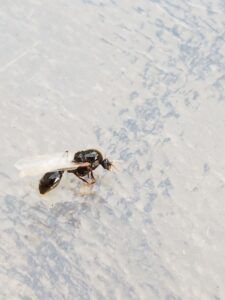
Fire ant swarmer (male) with wings.
For more information or help with identification, contact Wizzie Brown, Texas A&M AgriLife Extension Service Program Specialist at ebrown@ag.tamu.edu.
This work is supported in part by the Crop Protection and Pest Management, Extension Implementation Program [award no. 2021- 70006-35347/project accession no. 1027036] from the United States Department of Agriculture (USDA) National Institute of Food and Agriculture.
The information given herein is for educational purposes only. Reference to commercial products or trade names is made with the understanding that no discrimination is intended and no endorsement by Texas AgriLife Extension Service or the Texas AgriLife Research is implied. Extension programs serve people of all ages regardless of socioeconomic level, race, color, sex, religion, disability, or national origin.