Red Imported Fire Ants
Red imported fire ants are a non-native species that originated in South America. They were accidentally introduced to Mobile, Alabama, in the 1930s. At the time, ships used soil as ballast for stability, and it is believed that fire ants were unknowingly transported in soil removed from South American ships. From Mobile, fire ants spread throughout the southern United States, reaching Texas in the 1950s.
Fire ants bite and sting, and they can sting multiple times. The stinger, located at the tip of the abdomen, injects venom that can cause pain, burning, and redness. The sting area typically develops into a small pustule within a few days. This pustule may itch and is sterile unless it is broken open by scratching, which can lead to a secondary infection. Some people may develop an allergic reaction to fire ant stings or venom. Reactions can vary in severity, with some cases leading to life-threatening anaphylaxis. If you experience unusual or severe symptoms after being stung, seek medical attention.
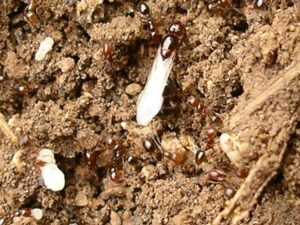
Fire ant management can be divided into two basic categories: broadcast treatments and individual mound treatments. Individual mound treatments target one mound at a time and are labor-intensive, requiring you to locate each mound. This approach can also result in more pesticide being applied overall. Broadcast treatments involve spreading a product (granular or bait) over a large area using appropriate equipment.
When using any pesticide, always read and follow all label instructions. Be sure to water in the pesticide if directed on the label, as failing to do so can reduce its effectiveness. However, baits should not be watered in or applied before rainfall, as they will not be collected by ants if they become wet.
For more information or help with identification, contact Wizzie Brown, Texas A&M AgriLife Extension Service Program Specialist at ebrown@ag.tamu.edu.
This work is supported by the USDA-NIFA Extension Implementation Program, project award no. 2024-70006-43508, from the U.S. Department of Agriculture’s National Institute of Food and Agriculture. Any opinions, findings, conclusions, or recommendations expressed in this publication are those of the author(s) and should not be construed to represent any official USDA or U.S. Government determination or policy.
The information given herein is for educational purposes only. Reference to commercial products or trade names is made with the understanding that no discrimination is intended and no endorsement by Texas AgriLife Extension Service or the Texas AgriLife Research is implied. Extension programs serve people of all ages regardless of socioeconomic level, race, color, sex, religion, disability, or national origin.