Spider Mites
It’s hot. It’s dry. It’s time to look for spider mites! Spider mite populations start out on the underside of leaves. While you may not be able to see the mites- depending on life stage, species, and your eyesight- you should be able to see the webbing they create. Feeding can cause discoloration of foliage leading to a speckled appearance. Severe infestations can cause foliage to turn silver or bronze and may result in leaves dropping from the plant.
Spider mites are arachnids, more closely related to spiders and ticks than insects. They can produce silk and often cover leaves with webbing. Webbing tends to start on the underside of leaves, but when populations grow larger, webbing expands to cover more of the foliage. Webbing helps protect the mites and their eggs from natural enemies and harsh environmental conditions and may sometimes protect them from pesticides.
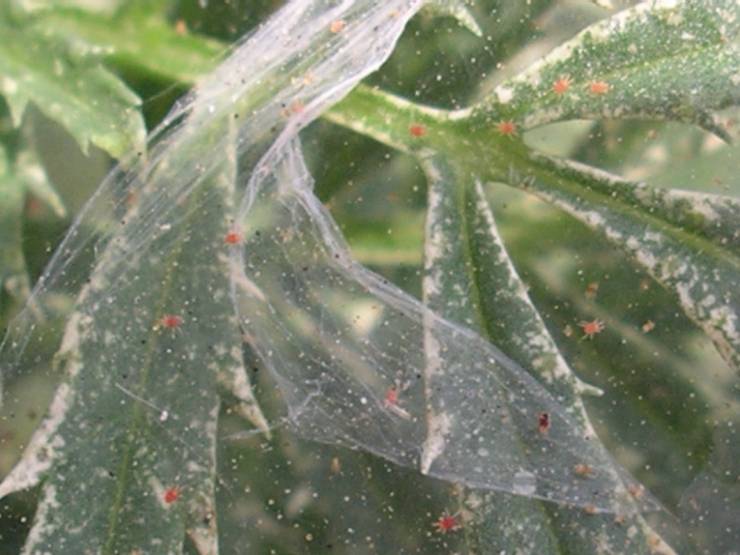
Spider mites lay their eggs along leaf veins during the growing season. The mites can develop more quickly when temperatures are warmer, with some spider mites going from egg to adult in less than a week. Further exacerbating spider mite problems is that spider mites thrive in dry conditions while their natural enemies require more humid conditions. Dry conditions allow spider mite populations to grow with little predation or parasitism that would help to keep populations at an acceptable level.
There are many predatory arthropods that feed on spider mites. Some of these include predatory mites, spider mite destroyers (a type of ladybug), minute pirate bugs, big-eyed bugs, and predatory thrips. Proper watering of plants may help reduce spider mite outbreaks as it can reduce plant stress brought on by drought. Using strong jets of water on plants can help to dislodge spider mites.
Miticides or acaricides can be used to manage spider mite outbreaks but use as a last resort. Some active ingredients can also kill beneficials and lead to worse spider mite problems since spider mites recover more quickly than their predators. Look for active ingredients such as horticultural oils (watch temperature when you use oils), insecticidal soaps, azadirachtin, or bifenthrin.
For more information or help with identification, contact Wizzie Brown, Texas A&M AgriLife Extension Service Program Specialist at ebrown@ag.tamu.edu.
This work is supported by the USDA-NIFA Extension Implementation Program, project award no. 2024-70006-43508, from the U.S. Department of Agriculture’s National Institute of Food and Agriculture. Any opinions, findings, conclusions, or recommendations expressed in this publication are those of the author(s) and should not be construed to represent any official USDA or U.S. Government determination or policy.
The information given herein is for educational purposes only. Reference to commercial products or trade names is made with the understanding that no discrimination is intended and no endorsement by Texas AgriLife Extension Service or the Texas AgriLife Research is implied. Extension programs serve people of all ages regardless of socioeconomic level, race, color, sex, religion, disability, or national origin.