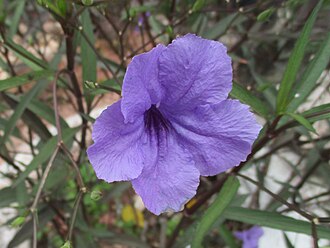
Mexican Petunia (Ruellia simplex)
VS
Dwarf Mexican Petunia (Ruellia brittoniana)
by CMG Kathleen S.
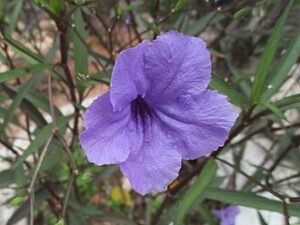
Mexican Petunia, Ruellia simplex, from commons.wikimedia.org by David Miller
Finding a dependable perennial ground cover that thrives in full sun, intense heat, and high humidity is a common challenge for gardeners, particularly in South Central Texas. The standard Mexican Petunia (Ruellia simplex, formerly known as R. brittoniana) often emerges as a candidate due to its exceptional tolerance of drought, heat, and seasonal flooding. However, its aggressive nature requires careful consideration and an emphasis on sterile or dwarf cultivars to protect local ecosystems.
The dwarf form of this plant first came to the attention of Dr. Wayne Mackay, a horticulture researcher then working at the Texas A&M AgriLife Research and Extension Center at Dallas. Dr. Mackay observed a specimen thriving in a neglected, narrow space between a sidewalk and a street in San Antonio. Despite the intense heat and total lack of maintenance, the plant displayed vibrant dark green foliage and prolific purple blooms. This exceptional durability led to the evaluation and eventual designation of the dwarf Mexican petunia as a Texas Superstar® plant.
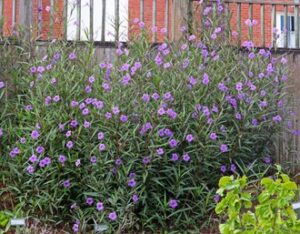
Ruellia simplex from commons.wikimedia.org by Don McCulley
While highly drought-tolerant once established, Ruellia simplex requires regular irrigation during its first growing season to develop an extensive root system. Under a managed watering schedule, bloom production increases dramatically. The leaves are green and sword like and the flowers are blue. The growth habit is tall and upright which grows to a height and width of 3 to 4 feet. It will bloom from late spring until frost. Fertilize once in the spring with a balanced or high-phosphorus fertilizer for optimal flowering. Pests are few and rarely bothered by snails or caterpillars. Ruellia simplex is root-hardy to USDA Zone 8. It is not frost-tolerant; the top growth will die back after a freeze, remaining dormant until it emerges from the roots the following spring.
Mexican Petunias (Ruellia simplex) are native to Mexico, western South America and the Antilles. Despite its landscape utility, this species poses significant ecological risks. They are an invasive plant because it spreads rapidly via vigorous underground rhizomes and flings seed prolifically. It is classified as an invasive species on the Texas Invasives Database.
When the species escapes cultivation, it aggressively colonizes naturalized spaces—such as municipal parks, riparian zones, and creek beds—forming dense monocultures that smother native understory vegetation. Gardeners should advise against planting the standard tall variety, particularly near waterways or sensitive natural boundaries.
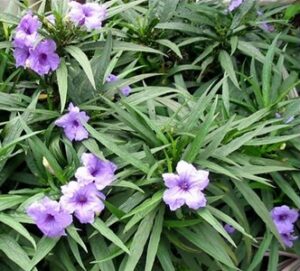
Katie Dwarf Ruelllia from txmg.org
To enjoy the heat-tolerance and pollinator benefits of Ruellia without the ecological fallout, Texas Master Gardeners should recommend sterile or low-fruiting dwarf selections:
- ‘Katie’ Dwarf Ruellia: The premier dwarf selection under the Texas Superstar® program. Growing just under a foot tall, it forms tidy, free-flowering ground covers that self-seed far less aggressively than the parent species. It requires no deadheading to maintain its clean appearance.
- ‘Purple Showers’: A sterile tall selection that grows to roughly 3 feet. While it spreads via rhizomes and must still be contained within defined borders, it does not produce viable seed, eliminating the risk of explosive wind-blown dispersal.
- Mayan™ Series: Developed through university breeding programs, these highly sterile cultivars provide large, showy blooms in distinct pink, white, and purple shades. Both pollen and seed production are genetically disrupted, rendering them safe for urban landscapes.
Ruellia selections remain highly attractive to hummingbirds, butterflies, and native bees. By steering the public away from the invasive wild species and toward certified Texas Superstar® dwarf options or sterile cultivars, gardeners can champion both water-wise resilience and responsible stewardship of local ecosystems.
References: texassuperstar.com, agrilifetoday.tamu.edu, southernliving.com, thespruce.com, gardeneros.com, livetoplant.com