Blow Flies
All new world screwworm flies are blow flies, but not all blow flies are new world screwworm flies. New world screwworm is a particular species of blow fly. With new world screwworm being the hot topic of the day- month? year?- I thought I would expand out to the larger grouping of blow flies. I’m not delving into the topic of new world screwworm in this article. If you want more information on that species, then click the link here.
Blow flies are in the Family Calliphoridae, and looking on iNaturalist, there are over 20 species found in Texas. They have a complete life cycle with four life stages- egg, larva (maggot), pupa, and adult. Eggs are laid in moist organic material where the larvae (maggots) emerge, live and feed. There are three larval instars, with each stage being larger than the last. When larvae are ready to pupate, they leave the moist area to seek out a drier area. The last larval “skin” is converted into a hardened shell, the puparium, where the pupae develop. Adult flies emerge from the puparium after about a week. Mated adult female blow flies can lay thousands of eggs, usually in batches of 100-300.
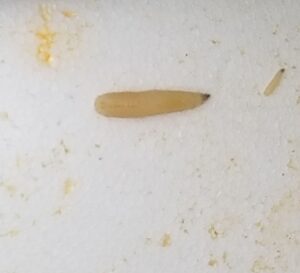 Maggots, or larvae, are creamy white and carrot shaped with their head at the pointy end of the body. Size of larvae varies depending on the age/ instar. The puparium is a reddish-brown seedlike structure. Adults look similar to house flies but are much more colorful. Blow fly adults are often metallic and come in colors such as blue, bronze, and green.
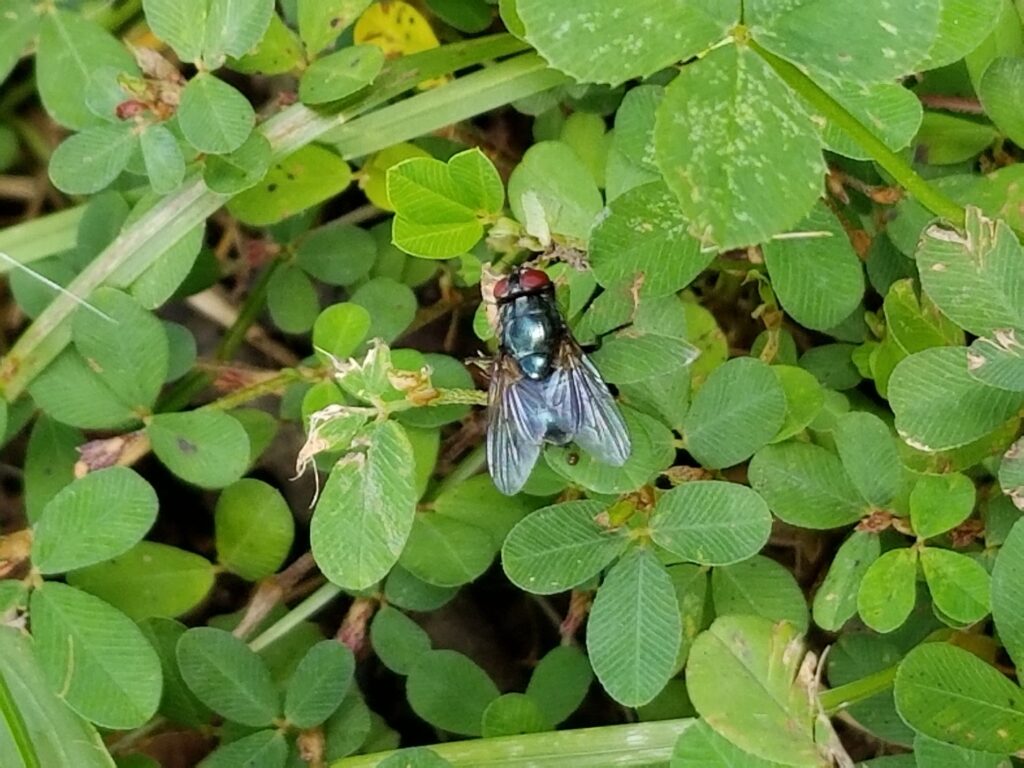 Blow fly larvae/ maggots feed on decaying organic matter, including carrion, fecal material, garbage, or other moist organic matter. Adult blow flies have a liquid diet and feed on things such as nectar, plant sap, rotting fruit, or liquids from fecal material or carrion.
Adults can be a nuisance, especially in summer months when their development time can decrease and there is often plenty of food for larvae. While adult flies are most annoying, management efforts need to focus on the larval stage. Locating and eliminating breeding sources is the best way to suppress fly populations.
- Eliminate any dead animals found on property
- Pick up pet waste at least once per week, seal in a bag and dispose of it in a trash can
- Manage compost areas and keep covered to keep flies from entering
- Use lids on garbage and recycling bins, take out regularly, and wash cans at least monthly
For more information or help with identification, contact Wizzie Brown, Texas A&M AgriLife Extension Service Program Specialist at ebrown@ag.tamu.edu.
This work is supported by the USDA-NIFA Extension Implementation Program, project award no. 2024-70006-43508, from the U.S. Department of Agriculture’s National Institute of Food and Agriculture. Any opinions, findings, conclusions, or recommendations expressed in this publication are those of the author(s) and should not be construed to represent any official USDA or U.S. Government determination or policy.
The information given herein is for educational purposes only. Reference to commercial products or trade names is made with the understanding that no discrimination is intended and no endorsement by Texas AgriLife Extension Service or the Texas AgriLife Research is implied. Extension programs serve people of all ages regardless of socioeconomic level, race, color, sex, religion, disability, or national origin.